IKVision transforms knowledge, rules, and decision logic into executable business processes. By combining Retrieval-Augmented Generation (RAG), Law as Code, LLM-based Business Agents, and controlled workflows, we create AI systems that are transparent, traceable, and auditable.
Many small and medium-sized enterprises do not operate with large, integrated IT systems. Instead, they rely on Excel spreadsheets, emails, PDFs, folder structures, and personal notes.
Valuable knowledge already exists – but it is scattered, difficult to find, and often requires significant effort to use effectively in day-to-day operations.
Information exists in different formats, is maintained inconsistently, and is often accessible only to the individuals who originally created it.
Information is available, but it is not structured, interconnected, or retrievable in a contextual manner. Relationships between documents, decisions, and business processes remain implicit and must be reconstructed repeatedly.
As a result, employees spend valuable time searching for, reviewing, and interpreting information instead of using it productively.
Knowledge is not systematically reused, decisions are derived multiple times, and errors occur whenever information is incomplete, outdated, or difficult to access.
This is where productivity is lost – not because information is missing, but because it is not available in a form that can be used directly within the business context.
IKVision makes existing knowledge accessible and actionable. Instead of introducing new systems, we consolidate existing information and place it into a shared, structured context.
Content is prepared in a way that allows it to be used directly in everyday business operations. The key is contextual delivery: information becomes available precisely when it is needed within a process.
This is enabled through Retrieval-Augmented Generation (RAG) and LLM-based Business Agents.
These technologies connect unstructured data with structured knowledge and support transparent, traceable decision preparation.
The underlying information remains fully transparent, verifiable, and professionally reviewable at all times.
Information is validated, consolidated, and made directly reusable for decisions, documentation, and subsequent process steps. The result is a digital assistant that reduces follow-up questions, minimizes errors, and actively supports existing business processes.
Implementation begins gradually and under control – with clearly defined use cases, measurable business value, and a scalable path for future expansion.
AI projects often appear unique – every use case seems different.
In practice, however, they follow a common and recurring structure.
The difference does not lie in the use case itself, but in the combination of a small number of clearly defined functional elements.
In engineering, complex processes have been decomposed into standardized functional building blocks for decades – known as Unit Operations. Each operation fulfills a clearly defined function and can be understood, combined, and optimized independently. This perspective is still missing in many AI projects today – and this is exactly where we begin.
AI Unit Operations transform individual requirements into systems: once structured in this way, they can be reused, extended, and operated in a controlled manner.
We apply the same principle to AI systems. We refer to these functional building blocks as: AI Unit Operations
The AI Unit Operations form the functional building blocks of this architecture.
Every use case follows the same system logic – from input through knowledge, rules, and evaluation to controlled action.
Input
Processing incoming information
Technologies
Knowledge
Retrieval of knowledge
Technologies
Logic
Application of rules
Technologies
Reasoning
Decision-making and evaluation
Technologies
Action
Execution of actions
Technologies
Control
Monitoring and validation of results
Technologies
AI Unit Operations standardize complex requirements and make them scalable, controllable, and reusable.
The reference architecture describes the functional building blocks of an AI system. In practice, these building blocks can be implemented using different technologies. The following example illustrates a Retrieval-Augmented Generation (RAG) workflow based on n8n, PostgreSQL, pgvector, and a Large Language Model.
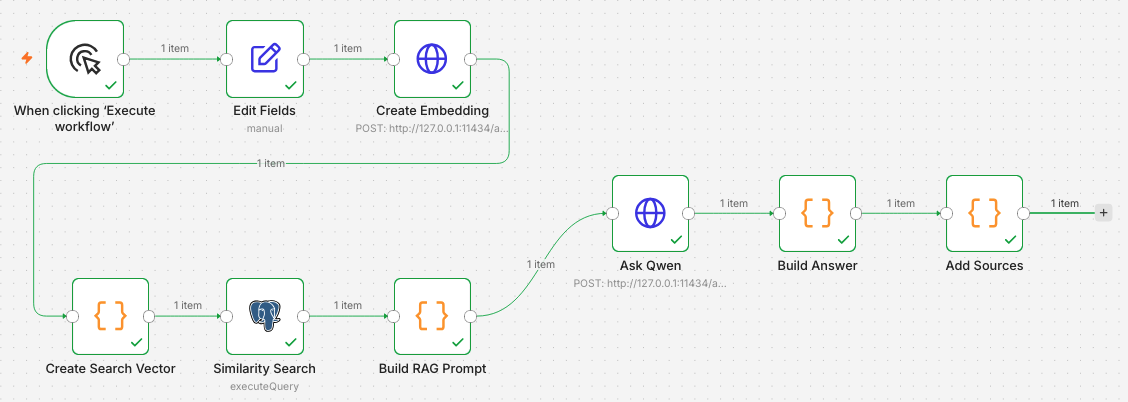
Example of a Retrieval-Augmented Generation (RAG) workflow using n8n, PostgreSQL/pgvector, and Large Language Models.
The workflow follows the same system logic as the AI Unit Operations: information is ingested, relevant knowledge elements are identified, embedded into context, processed by a language model, and finally returned with traceable source references.
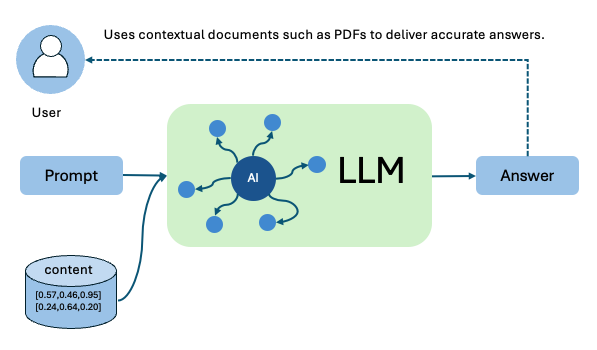
Question → Relevant Context → Verified Information → Answer
Texts are transformed into vectors by embedding models, mathematically representing their meaning.
Relevant information is retrieved through semantic similarity, regardless of the exact wording used.
An LLM generates precise answers based on verified internal information.
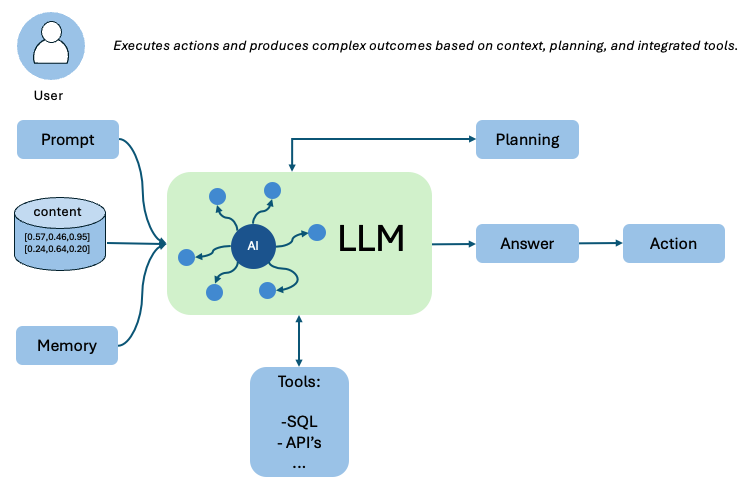
Goal → Context → Decision → Action → Feedback
LLM-based Business Agents are goal-oriented AI systems that combine a Large Language Model with contextual knowledge, planning capabilities, and connected tools.
They do more than answer questions—they analyze information, prepare decisions, and derive concrete next process steps.
An LLM Agent is a goal-oriented system that combines a Large Language Model with context, planning, state management, and tools such as databases, APIs, or email systems. It analyzes information, plans intermediate steps, uses tools, and evaluates its own results.
Unlike a chatbot, an LLM Agent does not merely answer questions. It actively determines what should happen next in order to achieve a defined objective. To do so, it analyzes information, plans intermediate actions, uses tools such as databases, APIs, or email systems, and validates its results. Decisions and states are stored and used for subsequent steps.
An LLM Agent is an AI-powered component that not only provides knowledge but actively translates it into decisions and business processes. It supports employees, prepares decisions, and automates defined process steps—in a controlled, transparent, and traceable manner, with optional Human-in-the-Loop supervision.
An LLM Agent pursues a defined objective, uses contextual information, operates in multiple steps, employs tools such as databases or APIs, and stores intermediate results for later actions. Another key characteristic is controlled autonomy: the agent operates within clearly defined technical and business boundaries.
Traditional automation follows fixed rules and predefined workflows. An LLM Agent, in contrast, can interpret content, consider context, and dynamically adapt its behavior to objectives, language, and circumstances. This makes it particularly suitable for variable processes, unstructured information, and individual decision-making scenarios.
Retrieval-Augmented Generation combines semantic search with language models. A RAG system first retrieves relevant information from internal documents, databases, or knowledge sources and then uses this information as context for response generation.
Vector databases store semantic representations of text as mathematical vectors. This allows information to be retrieved based on meaning rather than exact wording, even when a query uses different terms than the original document.
RAG reduces hallucinations by generating responses not only from a language model’s training data but also from specifically retrieved and verified internal sources. This makes answers more traceable, reliable, and professionally verifiable.
Local AI systems enable organizations to process sensitive data within their own infrastructure. This improves privacy, control, traceability, and integration with existing IT and compliance frameworks.
LLM Agents can analyze information, retrieve relevant sources, prepare decisions, derive next process steps, and trigger actions such as notifications, document generation, or workflow execution—under controlled conditions and with optional Human-in-the-Loop oversight.
Analysis of processes, data, and organizational requirements. Development of realistic AI roadmaps with a focus on business value, data protection, and practical implementation.
Semantic access to documents, databases, and domain knowledge. Reliable answers based on controlled enterprise data.
Transformation of laws, regulations, policies, and business rules into transparent, machine-readable decision logic.
Agents for analyzing information, preparing decisions, and executing process steps in a controlled and traceable manner.
We would be happy to discuss your processes, your data and your goals with you.
Contact IKVision