We translate legal norms and other text-based rule systems into machine-readable, executable decision logic – providing the foundation for transparent and controlled automation.
Many organizations operate based on clearly defined rules — but as long as these exist only as plain text, they are difficult to use in everyday operations. Each application requires repeated reading, interpretation, and derivation.
When rules exist only as text, decision-making remains a manual process. Laws, legal norms, policies, statutes, and internal guidelines are formulated in natural language.
They contain conditions, exceptions, exclusion criteria, and legal consequences — often distributed across multiple paragraphs, cross-references, and special provisions.
For practical application, this means:
Manual reconstruction
Decisions must be laboriously reconstructed from texts, references, and special cases.
Time-consuming justification
Justifications are time-intensive and not always consistently documented.
Limited scalability
Increasing case volumes lead to higher pressure on resources, time, and quality.
Lack of formalization
Automation often fails not due to domain complexity, but due to the absence of executable rule structures.
What is missing is not information. What is missing is an executable representation of the rule itself.
Not all areas of law are equally suitable for automation. The degree of suitability depends on how strongly a domain is characterized by clearly defined conditions, explicit requirements, and limited discretionary scope.
Typical application areas
Our goal is to identify the parts of legal and regulatory frameworks that are suitable for automation. We extract them from plain text. We then transform them into a cleanly structured, formally usable digital representation. This representation can be applied systematically and used repeatedly.
We translate rules expressed in natural language into structured decision logic. This logic is machine-readable and can be validated by domain experts. In this way, normative text is transformed into a digital, executable model. Rules are no longer just understood. They are applied and validated systematically. And they can be integrated into digital processes.
We analyze legal texts, statutes, policies, and administrative regulations to identify their decision-relevant structure.
The rule is transformed into machine-readable elements:
The rule is transformed into a structured decision model that can be processed technically and validated by domain experts.
Legal and domain experts review the formalized logic before it is used in production.
The model can be integrated into application workflows, business systems, validation processes, or assistance tools.
Every decision can be presented with justification, legal references, and clearly traceable validation steps.
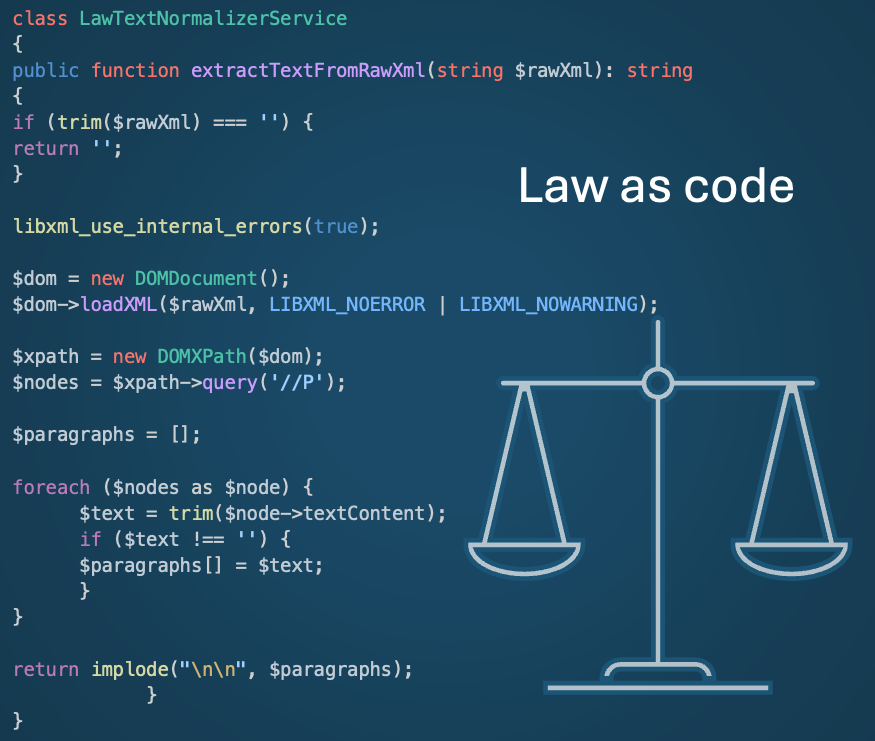
Law as Code describes the transformation of legal rules, regulations, and policies into machine-readable and executable decision logic.
Legal texts are analyzed and decomposed into structured components such as conditions, legal consequences, exclusion criteria, and special provisions. These components are then transformed into a formal decision model.
Traditional automation usually follows predefined technical workflows. Law as Code formalizes the rule and decision logic itself so that legal and regulatory requirements can be executed transparently and consistently.
Yes. By combining formalized rule logic with AI systems, decisions can be presented together with explanations, legal references, and traceable validation steps.
Deterministic models ensure consistency, traceability, and auditability of decisions. This is especially important in regulated domains such as social law, insurance, and compliance systems.
RAG systems connect structured decision logic with relevant documents, laws, and knowledge bases so that decisions can be made using current and context-specific information.
LLM agents can analyze documents, extract relevant information, structure data, and support validation processes within formalized decision systems.
Yes. Domains with clearly defined eligibility criteria, standardized evidence, and high volumes of recurring decisions are especially suitable for Law as Code approaches.
We create formal models that represent conditions, exceptions, legal consequences, and decision pathways in a technical structure.
We integrate modeled rule logic into existing digital processes, application workflows, and validation systems.
We combine language models with formalized rule logic to systematically validate unstructured inputs against defined requirements.
Together with you, we evaluate which rules, decisions, or administrative processes are suitable for technical and domain-driven automation.
We would be happy to discuss your processes, your data and your goals with you.
Contact IKVision